Your Custom Text Here
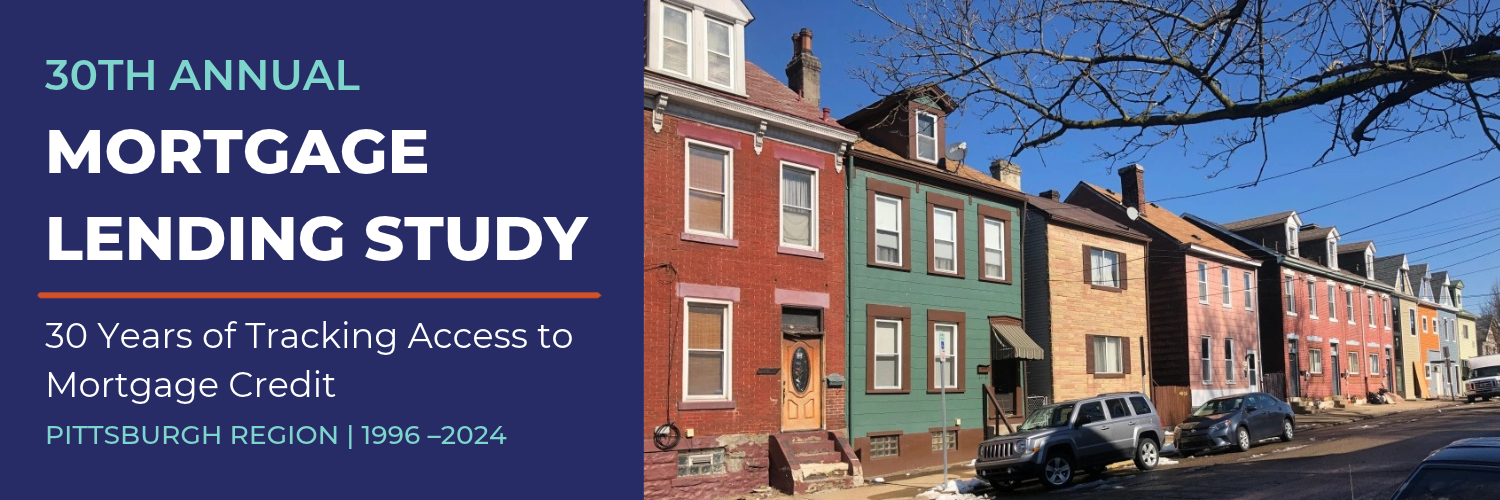
2026 Mortgage Lending Study
30 Years of Lending Studies: Banking, Credit and the Continuing Fight for Community Reinvestment
Thirty years ago, Pittsburgh Community Reinvestment Group published its first annual lending study. The purpose was straightforward: to use publicly available lending data to understand who was receiving credit, which neighborhoods were being left behind, and whether financial institutions were meeting their obligations to the communities they served.
Much has changed since that first study in 1996. The banking system that Pittsburghers interact with today would be almost unrecognizable to someone opening a bank account or applying for a mortgage three decades ago. Yet, one thing has remained remarkably consistent: access to credit continues to shape who can buy a home, build wealth, start a business, improve a neighborhood and remain rooted in their community.
For three decades, PCRG's lending study has provided a way to measure that access.
A Banking System Transformed
When PCRG released its first lending study, banking was still fundamentally a physical, local experience. Consumers visited branches, deposited checks with tellers and met with loan officers face-to-face. Bank branches were central to how financial institutions connected with their communities, and where those branches were located mattered.
Since then, the banking industry has undergone extraordinary consolidation. In 1996, there were more than 9200 FDIC-insured banking organizations and institutions in the United States. By 2025, that number had fallen to 4336 insured institutions. The number of banks has continued to decline even as the average size of surviving institutions has grown.
Pittsburgh has experienced this transformation firsthand. Institutions that were once familiar local or regional names have been absorbed into larger organizations, while today's banking landscape is dominated by a smaller number of institutions operating across much larger geographic footprints. For example, PNC grew through a series of acquisitions during the 1990s, while the 2008 acquisition of National City further reshaped banking in Pittsburgh and across the region.
At the same time, the way people bank has changed. Online banking, mobile deposits, automated underwriting, digital applications, and electronic payments have reduced the importance of the physical branch. A consumer can now apply for a mortgage from a phone, deposit a check without entering a bank and maintain a relationship with an institution headquartered hundreds or thousands of miles away.
These changes have brought convenience and expanded access in many ways. But they have also raised an important question: What does it mean for a bank to serve a community when it may have few — or even no — physical branches there?
That question sits at the heart of the modern Community Reinvestment Act.
Housing and Mortgage Lending Have Changed Too
The housing market has also moved through dramatic cycles over the past 30 years. The late-1990s housing expansion gave way to the foreclosure and financial crisis of the late 2000s. A prolonged recovery was followed by the extraordinary housing and mortgage market disruption of the COVID-19 pandemic, when historically low interest rates fueled a surge in home purchases and refinancing. More recently, higher interest rates have sharply reduced mortgage activity and created a market where affordability remains a major barrier for prospective homebuyers.
The structure of mortgage lending itself has changed. Banks remain important mortgage lenders, but nonbank mortgage companies now play a dominant role. In the five-county region examined in PCRG's most recent study, mortgage companies originated more than 60 percent of home purchase loans in 2023.
That shift matters because the Community Reinvestment Act applies to federally insured banks and thrifts—not to the growing universe of nonbank mortgage companies. As more mortgage lending moves outside the banking system, a growing share of the institutions making decisions about who receives mortgage credit are not subject to CRA obligations.
This distinction is increasingly important for community reinvestment: a growing share of mortgage lending is being conducted by institutions outside the federal CRA framework.
This is one of the central challenges facing community reinvestment today: the financial system has evolved beyond the system that CRA was originally designed to oversee.
Thirty Years of CRA — and a Continuing Fight
The Community Reinvestment Act was enacted in 1977 in response to the systemic disinvestment and redlining that had denied credit to low- and moderate-income communities and communities of color. PCRG itself was organized in 1988 as a coalition of community organizations responding to redlining and has used CRA as a central tool for advocating for reinvestment in Pittsburgh neighborhoods.
When PCRG's first lending study was published in 1996, CRA had already been amended, and its implementing regulations had just been substantially revised in 1995. Those rules were developed for a banking environment in which branches, deposits and traditional bank lending were central measures of how institutions served their communities.
Thirty years later, that framework has struggled to keep pace.
There have been repeated attempts to modernize the CRA. In 2023, federal banking regulators finalized the first major overhaul of CRA regulations since 1995, attempting to account for online banking and evaluate lending activity beyond the traditional footprint of physical branches. The effort recognized an obvious reality: banks no longer serve communities solely through brick-and-mortar locations.
But the modernization did not last. In 2025, regulators rescinded the 2023 framework and returned to the 1995 regulatory framework amid litigation and concerns about the scope and complexity of the new rules.
And the fight continues in 2026.
This year, the Office of the Comptroller of the Currency and Federal Deposit Insurance Corporation proposed another significant change to CRA rules—without the Federal Reserve joining the proposal. Among other changes, the proposal would raise the asset threshold for banks receiving certain exemptions and reduce the number of institutions subject to the most comprehensive CRA requirements.
For communities that have spent generations fighting for equitable access to credit, these are not simply technical regulatory changes. They determine which institutions are accountable, what lending and investment are measured, and how communities can advocate for the resources they need.
For PCRG and its members, the question is not simply how CRA rules are written. It is how those rules affect the institutions that communities rely on for mortgages, small-business credit, affordable housing investment and other forms of community development financing.
Why This Study Still Matters
Thirty years of lending data tell us something important: the tools and institutions may change, but disparities in access to credit do not disappear on their own.
PCRG's annual lending study exists because communities need an independent, transparent way to understand what is happening in the lending market. HMDA data gives us the ability to examine who receives mortgages, who is denied, where lending is occurring and where gaps persist. Over time, the study has expanded alongside the financial system, providing a longer and more detailed record of how lending patterns have changed across Pittsburgh and Southwestern Pennsylvania.
The value of that record is not simply historical. It gives communities a basis for action.
It allows residents and community organizations to ask banks difficult questions. It gives policymakers evidence to inform housing and economic development policy. It gives regulators information that can help evaluate whether financial institutions are meeting their obligations. And it gives lenders an opportunity to identify gaps and work with communities to develop solutions.
Thirty years ago, the fight was against redlining and overt disinvestment. Today, the challenges are more complicated. They include the affordability crisis, persistent racial disparities in homeownership, the growing role of nonbank lenders, the decline of traditional branches, bank consolidation, algorithmic and automated lending decisions, and a regulatory framework struggling to keep pace with a rapidly changing financial system.
The lesson of three decades of PCRG lending studies is not that nothing has changed. A great deal has changed.
The lesson is that change in the financial system does not automatically produce equity.
That is why CRA still matters. And that is why PCRG's work still matters.
As we mark the 30th anniversary of this study, we are not simply looking backward at three decades of lending data. We are looking forward to the next generation of questions: Who will have access to credit? Which institutions will be accountable to our communities? How will banks and other financial companies be expected to reinvest in the places where they do business? And what role will community organizations play in making sure that technological and financial innovation does not leave historically underserved communities behind?
For 30 years, PCRG has helped make those questions visible through data, research and advocacy.
The banking system may look very different than it did in 1996. The need for community reinvestment does not.